Optimizing Large Language Models: The Impact of TurboQuant on KV Cache Compression
Introduction
Large language models (LLMs) have revolutionized natural language processing, but their deployment comes with significant computational and memory challenges. One critical bottleneck is the key-value (KV) cache, which stores intermediate states during inference. As models scale, the KV cache can grow to enormous sizes, limiting throughput and increasing latency. Recently, Google introduced TurboQuant, a novel algorithmic suite and library designed to address this issue through advanced quantization and compression techniques. This article explores how TurboQuant is transforming AI systems, particularly in retrieval-augmented generation (RAG) pipelines.
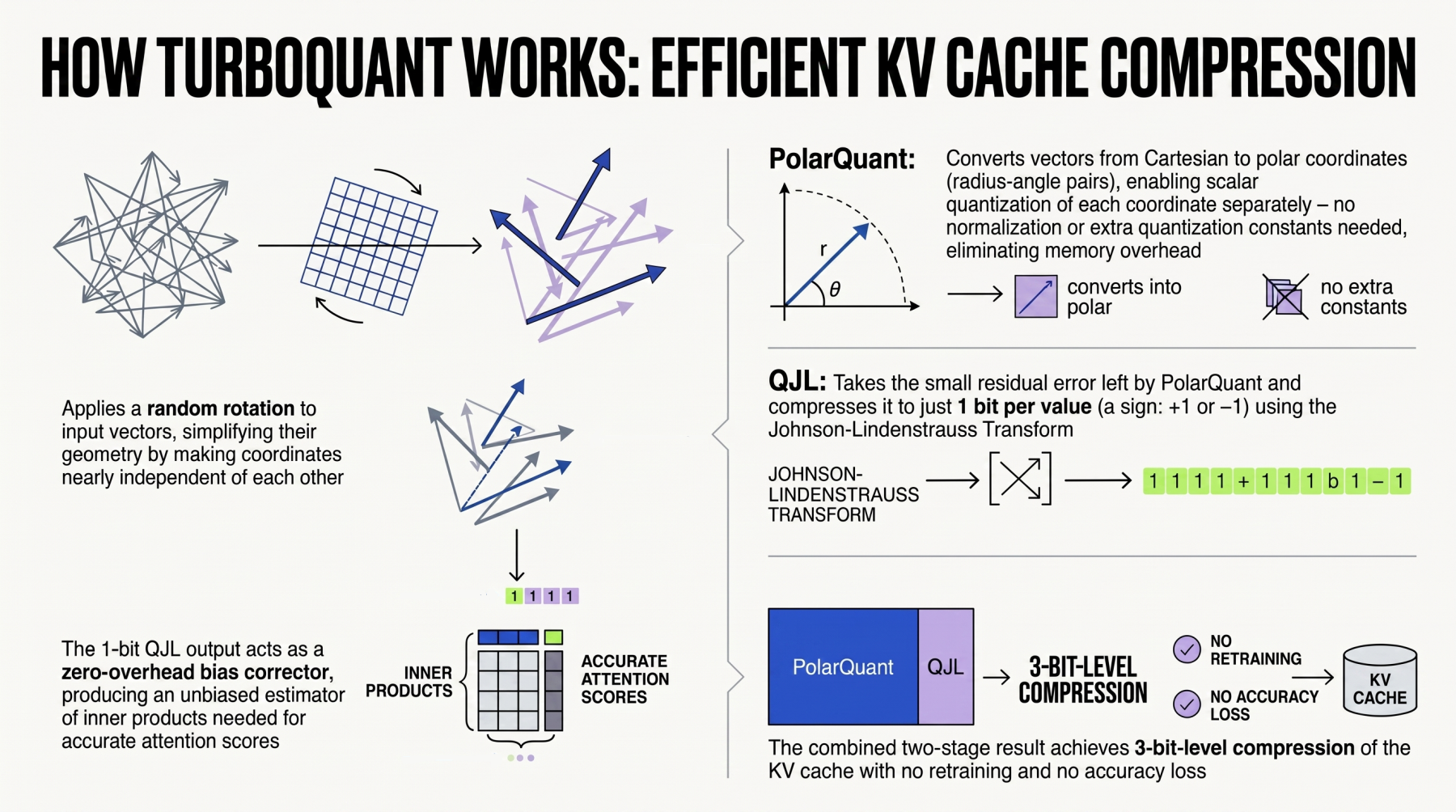
Understanding the KV Cache Bottleneck
In transformer-based LLMs, attention mechanisms compute attention scores using queries, keys, and values. During autoregressive decoding, the model must retain keys and values from all previous tokens to predict the next token. This persistent cache grows linearly with sequence length, consuming substantial GPU memory. For example, a 7-billion-parameter model with a 2,048-token context can require gigabytes of memory solely for the KV cache. This limits batch sizes, increases energy costs, and hampers real-world applications like chatbots and code assistants.
Why Compression Matters
Compressing the KV cache reduces memory footprint without sacrificing accuracy. Traditional approaches include pruning, low-rank approximations, and quantization—mapping floating-point values to lower bit-widths (e.g., 8-bit or 4-bit integers). Effective compression not only lowers hardware requirements but also speeds up inference by reducing memory bandwidth usage. However, aggressive compression can introduce errors that degrade model quality, making a careful algorithmic design essential.
TurboQuant: A New Horizon in Quantization
Google's TurboQuant is not just another quantization library; it represents a holistic algorithmic suite. It combines innovative quantization schemes with efficient library implementations, targeting both LLMs and vector search engines—a cornerstone of RAG systems. By optimizing KV cache compression, TurboQuant addresses the dual challenges of memory and speed.
Key Features of TurboQuant
- Adaptive quantization: Automatically adjusts bit-width based on layer sensitivity, preserving accuracy where it matters most.
- Hardware-aware calibration: Uses profiling data to tune compression for specific GPU architectures, maximizing throughput.
- Seamless integration: Offers easy-to-use APIs that plug into popular frameworks like PyTorch and JAX.
- Support for vector search: Extends quantization to embedding vectors, crucial for efficiency in RAG databases.
Benefits for LLM Inference
Applying TurboQuant to the KV cache yields several tangible advantages:
- Memory reduction: Reports show up to 4× compression ratios with minimal perplexity loss, enabling larger batch processing on the same hardware.
- Latency improvement: Fewer memory transfers accelerate decoding speed, reducing time-to-first-token and overall generation time.
- Cost efficiency: Lower resource consumption translates to reduced cloud compute costs, making LLMs more accessible for small to medium enterprises.
TurboQuant in RAG Systems
Retrieval-augmented generation relies on vector search engines to fetch relevant documents from a knowledge base. These engines store high-dimensional embeddings, which can be memory-intensive. TurboQuant's compression techniques apply directly to these vectors, enabling larger indices or faster search. By reducing the memory footprint of both the LLM's KV cache and the vector database, TurboQuant optimizes the entire RAG pipeline.
Real-World Implications
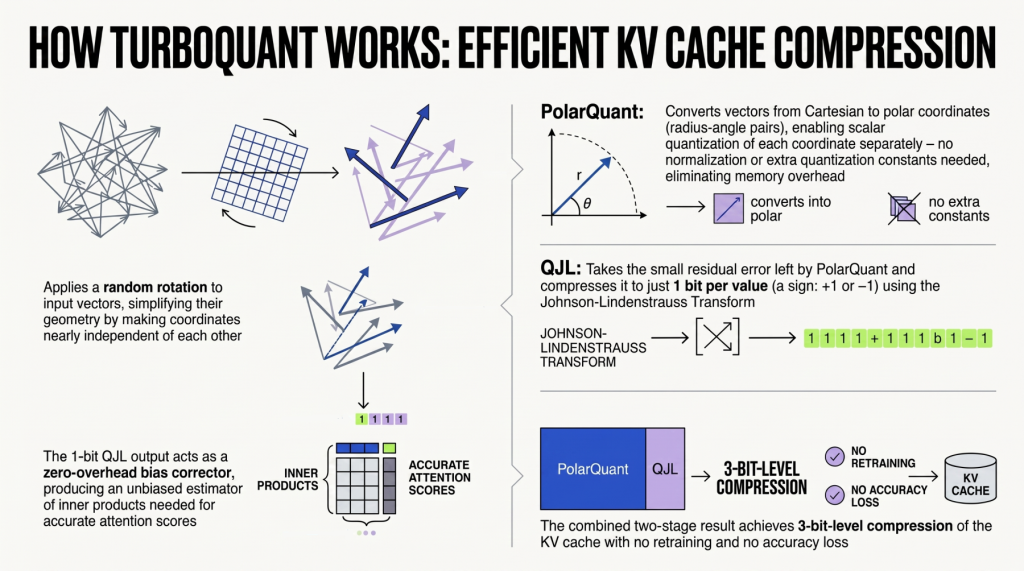
For companies deploying AI assistants, TurboQuant can mean serving more concurrent users without scaling hardware. For researchers, it allows experimenting with longer context lengths on limited resources. In fields like medicine or legal analysis, where context is critical, this compression unlocks new capabilities previously impractical due to memory constraints.
Comparative Analysis with Existing Methods
Previous works such as GPTQ, AWQ, or SmoothQuant have focused on weight quantization. TurboQuant stands out by targeting the KV cache specifically and combining it with vector quantization. Its algorithmic innovations—like per-channel scaling and dynamic outlier handling—achieve better accuracy-compression trade-offs. Moreover, its open-source library ensures reproducibility and community-driven improvements.
Getting Started with TurboQuant
Developers can experiment with TurboQuant through its official library, which includes pre-built configurations for popular models like LLaMA, Mistral, and Gemma. The documentation guides users through calibration, quantization, and deployment steps. With minimal code changes, teams can apply TurboQuant to their existing LLM pipelines and immediately observe performance gains.
Future Directions
The landscape of LLM optimization is rapidly evolving. TurboQuant's success suggests that further improvements in dynamic quantization and hardware co-design are on the horizon. As models grow, innovations like TurboQuant will be essential for democratizing AI, making high-performance inference feasible across diverse environments.
Conclusion
TurboQuant represents a significant leap in making large language models more efficient. By focusing on KV cache compression and vector search optimization, it addresses a core bottleneck that limits scalability. Whether you're building a production-grade chatbot or exploring RAG applications, TurboQuant offers a practical path to enhanced performance. As Google and the open-source community continue to refine it, we can anticipate even greater strides in AI deployment efficiency.