How Spotify Wrapped 2025 Works: The Engineering Behind Your Year in Music
Every December, millions of Spotify users eagerly await their personalized Wrapped experience — a colorful, shareable summary of their listening habits over the past year. But have you ever wondered what happens behind the scenes to turn raw streaming data into those insightful highlights? In this Q&A, we pull back the curtain on the technology, data pipelines, and machine learning models that power the 2025 Wrapped campaign.
1. How does Spotify collect and process the data for Wrapped?
Spotify ingests terabytes of streaming data every day — including play counts, skip rates, session durations, and even the time of day you listen. For Wrapped, engineers run parallel batch processing pipelines using Apache Beam and BigQuery to aggregate each user's activity across the entire year. This data is cleaned, deduplicated, and anonymized before being fed into the personalization engine. The entire workflow is orchestrated to complete within days, ensuring every user gets their customized summary on launch day.
2. What machine learning models help identify your 'wrapped' moments?
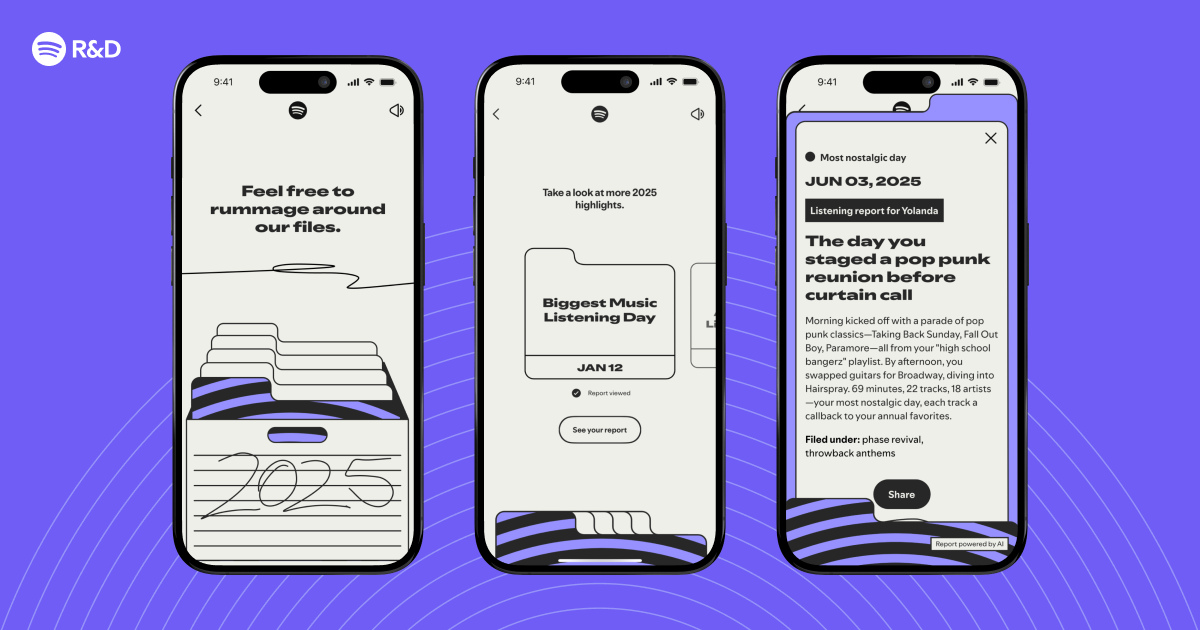
Several models work together to surface your most interesting listening moments. A recurrent neural network (RNN) analyzes temporal patterns to detect when you discovered new artists or revisited old favorites. A separate clustering algorithm groups genres and moods you engaged with most. And a transformer-based model (similar to BERT) interprets your playlist creates and podcast skips to infer narrative arcs — like “your summer soundtrack” or “the week you binged electronic music.” All these outputs feed into a ranking system that selects the top 10 highlights for each user.
3. How does Spotify ensure data privacy while delivering personalized highlights?
Privacy is built into every layer of the Wrapped pipeline. All raw streaming data is stored in encrypted data lakes with strict access controls. The personalization engine uses differential privacy techniques, adding calibrated noise to aggregate stats (e.g., “you were in the top 1% of listeners” only when the group is large enough). User identifiers are hashed and never stored alongside derived insights. Additionally, the models are trained on anonymized datasets, and users can opt out of Wrapped entirely via their account settings.
4. What technology powers the audio analysis for 'Your Top Songs'?
To determine your top songs, Spotify combines streaming frequency with acoustic features extracted by its audio analysis system. This system uses a convolutional neural network (CNN) to process raw audio waveforms and extract features like tempo, key, loudness, and danceability. A separate model analyzes lyrics sentiment via a fine-tuned RoBERTa model. These features are then compared against your personal listening history to rank songs not just by play count, but by emotional impact and listening context — ensuring the list feels truly representative of your year.

5. How are the visual assets and interactive stories generated at scale?
Wrapped’s vibrant graphics and stories are generated by a creative automation system built on top of Spotify’s design toolkit. For each user, a server-side microservice renders personalized SVG templates using JavaScript on Node.js. The system pulls in data from the personalization engine — like your top artist, genre, and listening minutes — and dynamically inserts them into pre-designed layouts. These SVGs are then converted to shareable PNGs using headless Chromium. To handle the load, the rendering farm scales horizontally across hundreds of AWS EC2 instances, producing millions of unique images within hours.
6. How does Spotify handle the massive traffic spike on Wrapped launch day?
Wrapped launch day sees traffic 50x higher than normal. Spotify’s infrastructure team prepares by horizontally scaling its web services and read replicas across multiple cloud regions. They employ a combination of CDN caching (for static assets) and a distributed cache layer (for personalization results) using Redis and Memcached. An auto-scaling group of Kubernetes pods handles user requests, while a circuit breaker pattern prevents cascading failures. The team also runs a full-scale load test two weeks before launch, simulating peak traffic to identify and fix bottlenecks.
7. What challenges did the team overcome for Wrapped 2025?
For 2025, the biggest challenge was incorporating new data types — such as podcast replay segments and collaborative playlist contributions — into the personalization pipeline. The team had to build a unified data model that could handle both music and podcasts without inflating latency. They also faced a tight deadline to train a new mood-detection model that uses multi-modal data (audio + metadata). Through agile sprints and a dedicated “Wrapped strike team,” the engineers delivered on time, with a 99.99% success rate in generating highlights for every eligible user.