A Step-by-Step Guide to Meta's Enhanced End-to-End Encrypted Backup Infrastructure
Introduction
Meta has fortified its end-to-end encrypted backups for WhatsApp and Messenger by deploying a sophisticated HSM-based Backup Key Vault. This guide walks through the key steps Meta takes to secure your message history—from tamper-resistant hardware to transparent fleet deployments. Whether you're a security enthusiast or a developer, you'll understand the infrastructure that keeps your backups safe from third parties, including Meta itself.
What You Need
To follow Meta's approach, you'd need these components and partnerships:
- Hardware Security Modules (HSMs) – Tamper-resistant devices that store recovery codes and cryptographic keys.
- Geographically distributed data centers – A fleet of HSMs spread across multiple locations for resilience.
- Majority-consensus replication – A system where a quorum of HSMs must agree to authorize operations.
- Cloudflare – An independent third-party that signs validation bundles and maintains audit logs.
- Over-the-air key distribution mechanism – For delivering fleet public keys without requiring app updates.
- Public blog and whitepaper – To publish evidence of secure deployments and provide full technical specs.
Step 1: Deploy the HSM-Based Backup Key Vault
The foundation of Meta's strengthened backups is the HSM-based Backup Key Vault. This system allows users to protect their backed-up message history with a recovery code, stored exclusively in tamper-resistant HSMs. Meta, cloud storage providers, or any third party cannot access these codes.
- Set up a geographically distributed fleet of HSMs – Deploy multiple HSM nodes across several data centers to ensure availability even if one location fails.
- Implement majority-consensus replication – Configure the HSMs so that a quorum (more than half) must agree before any operation is performed. This prevents a single compromised HSM from leaking keys.
- Hardcode fleet public keys (for WhatsApp) – In WhatsApp, the fleet's public keys are burned into the app binary, so clients can verify they're talking to authentic HSMs.
- Allow recovery code generation – When a user sets up backup, the system creates a recovery code and stores it in the HSM vault, giving the user a way to restore their messages later.
Step 2: Implement Over-the-Air Fleet Key Distribution
For Messenger, Meta needed a more flexible approach because HSM fleet deployments can happen without updating the app. They built an over-the-air (OTA) mechanism to distribute fleet public keys.
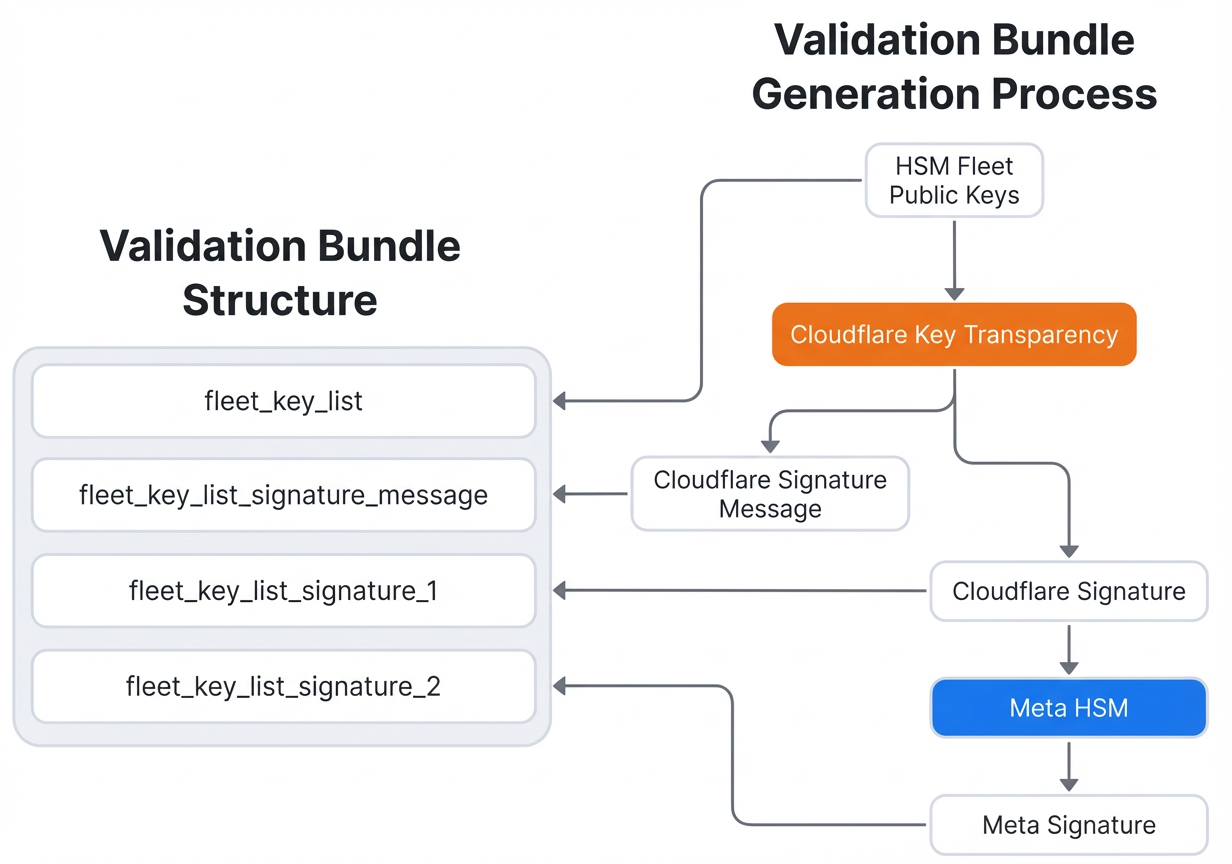
- Create a validation bundle – This bundle contains the new fleet's public keys and metadata. It's first signed by Cloudflare (an independent third party) and then counter-signed by Meta.
- Deliver the bundle during HSM response – When a Messenger client establishes a session with an HSM fleet, the server includes the validation bundle in its response. The client can verify both signatures.
- Verify independently – Clients check Cloudflare's signature and Meta's counter-signature to ensure the fleet keys are genuine and have not been tampered with. Cloudflare also maintains an audit log of every validation bundle issued.
- Continue without app updates – Because the keys arrive OTA, new HSM fleets can be deployed seamlessly, and clients always have the latest authenticated keys.
Step 3: Publish Evidence of Secure Fleet Deployments
Transparency is essential to demonstrate that the system operates as designed. Meta now publishes cryptographic evidence of each new HSM fleet deployment on its public blog.
- Perform a secure deployment – Each new fleet is provisioned in a controlled manner, with HSMs configured and tested to meet security requirements.
- Generate evidence of secure deployment – This includes cryptographic attestations, measurements, and proofs that the fleet was deployed with integrity. The exact steps are detailed in Meta's whitepaper, 'Security of End-To-End Encrypted Backups'.
- Publish the evidence – Meta posts the evidence on this Engineering blog along with a commitment to continue doing so for all future fleet deployments (which are infrequent, typically every few years).
- Invite verification – Any user can follow the instructions in the Audit section of the whitepaper to verify that the published evidence matches the actual deployed fleet, confirming that Meta cannot access backups.
Tips for Verification and Trust
- Always check for the latest deployment evidence – Visit Meta's engineering blog periodically to see if a new fleet has been deployed and to review the accompanying proof.
- Understand the audit steps – Read the whitepaper's Audit section to learn how to independently verify fleet deployments. This gives you hands-on confidence in the system.
- Use passkeys when available – Meta made it easier to end-to-end encrypt backups using passkeys. Consider enabling passkey-based recovery for added convenience without sacrificing security.
- Remember that the recovery code is your responsibility – The HSM vault stores your recovery code, but if you lose it, Meta cannot help you recover your backup. Save it in a secure password manager or offline.
- Beware of phishing – Only trust validation bundles that come directly from Cloudflare and Meta. Never enter your recovery code on a website that isn't the official app.
For the complete technical specification, read the full whitepaper: Security of End-To-End Encrypted Backups.