Breaking the Forking Trap: Meta's Dual-Stack WebRTC Architecture for Seamless Upgrades
Introduction
Real-time communication (RTC) is the backbone of many Meta services, powering everything from global video calls on Messenger and Instagram to low-latency cloud gaming and immersive VR casting on Meta Quest. To meet the demands of billions of users, Meta spent years developing a specialized, high-performance variant of the open-source WebRTC library. However, permanently forking a large open-source project often leads to a common industry pitfall: the forking trap. What begins as a well-intentioned internal optimization or quick bug fix can gradually isolate the fork from upstream improvements, making community upgrades prohibitively costly. Recently, Meta concluded a massive multiyear migration to break this cycle, moving over 50 use cases from a divergent fork to a modular architecture built on top of the latest upstream version. This article details how they engineered a solution that enables safe A/B testing, continuous upgrades, and coexistence of two WebRTC versions within a single library.
The Challenge: Monorepo and Static Linking
Upgrading a library like WebRTC while serving billions of users is inherently risky. A one-time upgrade could introduce regressions that are hard to roll back, especially given the wide variety of devices and network conditions. Meta needed to A/B test the new upstream version alongside the legacy version within the same application, dynamically switching users between them to verify performance and stability. This required statically linking two copies of WebRTC in the same binary—a direct violation of the C++ One Definition Rule (ODR), which would cause thousands of symbol collisions.
One Definition Rule Violations
In a monorepo environment, static linking is the norm, and the linker expects each symbol to appear only once. Having two versions of WebRTC with identical function and variable names leads to linker errors and undefined behavior. Simply placing them in separate namespaces is insufficient because WebRTC uses global symbols extensively. Meta needed a way to make two versions coexist in the same address space without conflicts.
The Dual-Stack Solution
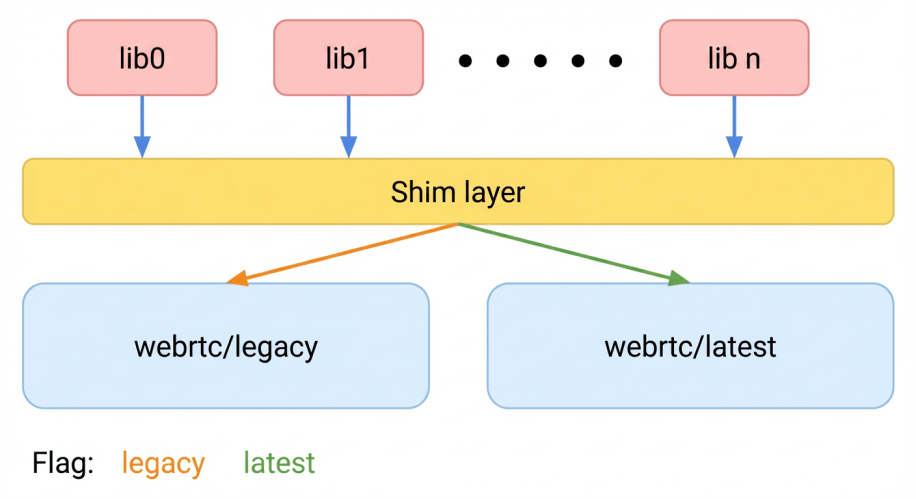
To bypass ODR violations, Meta built a dual-stack architecture that encapsulates each WebRTC version behind a thin abstraction layer. This layer uses custom symbol prefixes and indirect function calls to avoid direct collisions. By compiling the legacy and upstream versions with different preprocessor macros, they generated unique symbol names for each build. The result is two fully independent WebRTC stacks living in the same process, each with its own set of globals and static variables.
A/B Testing at Scale
With two stacks operational, Meta could randomly assign user sessions to either the legacy or the new version. This allowed them to measure critical metrics like call setup time, video quality, and crash rates across 50+ use cases—from Messenger voice calls to Cloud Gaming streams. The A/B testing framework was integrated into their existing experiments infrastructure, enabling fine-grained rollouts and automatic rollbacks if regressions were detected.
Continuous Upgrade Workflow
Once the dual-stack architecture was in place, Meta established a continuous upgrade pipeline. Each new upstream WebRTC release is automatically pulled, patched with Meta-specific optimizations, and integrated as the “new” stack. The legacy stack is then compared through A/B tests. Only after proven safe is the new stack promoted to be the default, while the old stack becomes the new baseline for the next upgrade cycle. This workflow eliminates the forking trap by ensuring that Meta’s codebase never drifts far from upstream—patches are tiny and easy to merge.
Results and Benefits
The new architecture delivered measurable improvements across performance, binary size, and security. By staying current with upstream, Meta automatically benefits from community bug fixes and security patches. Binary size increased only marginally due to the dual-stack overhead, but the ability to continuously upgrade without freezing the codebase more than offsets that cost. Today, every WebRTC update at Meta goes through this A/B testing process before reaching users, ensuring a stable and high-quality real-time communication experience.
Conclusion
Meta’s escape from the forking trap demonstrates a scalable approach to maintaining large open-source dependencies. By investing in a dual-stack architecture and a rigorous continuous upgrade workflow, they transformed a risky, static fork into a dynamic, testable component. This strategy not only improved the reliability of real-time communications but also freed engineering resources from manual merge efforts, allowing them to focus on innovations that directly benefit billions of users. For any organization relying on a core open-source library, this case study offers a blueprint for avoiding the classic fork-and-diverge problem.