Step-by-Step: The Engineering Behind V8’s 2x Faster JSON.stringify Optimization
Introduction
Have you ever wondered how a core JavaScript function like JSON.stringify can be made more than twice as fast without changing your code? The V8 team recently achieved exactly that, and the underlying engineering is a masterclass in optimization. This guide breaks down the exact steps they took, from identifying performance bottlenecks to implementing a specialized fast path. By the end, you'll understand what happens inside the engine when you serialize data and how future-proof your applications can benefit.
What You Need
- Basic knowledge of JavaScript engines – understanding concepts like interpreters, compilers, and garbage collection helps.
- Familiarity with JSON.stringify – you should know its purpose and typical usage patterns.
- A desire to learn low-level performance techniques – no code changes are required, but we’ll dive into compiler internals.
Step 1: Recognize the Performance Gap in JSON.stringify
The journey begins with a simple observation: JSON.stringify is a critical function used everywhere – from serializing data for AJAX calls to saving state in localStorage. Even small improvements ripple across millions of websites. The V8 team measured the existing performance and found that the generic serializer had to be defensive, checking for side effects at every node. This overhead made it slower than necessary for the most common use cases: serializing plain data objects.
Step 2: Identify the Costly Side Effects
To speed things up, you must first understand what slows them down. During serialization, JavaScript can run arbitrary user code via toJSON() hooks, getters, or proxy traps. Even internal operations like garbage collection (GC) can be triggered by certain string representations (e.g., ConsString flattening). These are called side effects – anything that breaks the simple, linear traversal of an object’s properties. The original serializer had to pause and check for these at every step, which caused expensive branching and defensive logic.
Step 3: Design a Side-Effect-Free Fast Path
Once side effects are identified, the key insight is: if V8 can guarantee that no side effects will occur during serialization, it can take a much faster, specialized route. This “fast path” is built on static analysis – V8 checks the object’s shape, property types, and absence of getters or custom toJSON before starting. If everything is clean, it bypasses the heavy checks of the slow path. The new fast path is also iterative instead of recursive, which eliminates stack overflow checks and allows deeply nested objects (up to 100k+ levels) to be serialized without crashing.
Step 4: Switch from Recursive to Iterative Traversal
Why iterative? A recursive serializer would push a new call stack frame for each nested object, quickly hitting limits and requiring costly overflow checks. The iterative approach uses a custom stack data structure carefully managed to avoid GC. This not only speeds up traversal but also enables fast resume after encoding changes (e.g., switching between string types). The result: more consistent performance for real-world datasets with deep hierarchies, like JSON APIs.
Step 5: Optimize String Handling with Templatized Code
Strings are the biggest contributors to serialized size. In V8, strings can be one-byte (ASCII) or two-byte (JavaScript’s UCS-2). Checking the character width on every write wastes CPU cycles. The solution: templatize the entire stringifier on character type. Two separate, optimized versions of the core loop are compiled: one for pure ASCII strings, another for two-byte strings. This removes runtime branching and type checks, making each path as lean as possible. The trade-off is a slight increase in binary size, but the performance gains are worth it.
Step 6: Handle Mixed Encodings and Fallback Gracefully
Not all objects fit the fast path. For example, a string may be a ConsString (a concatenation of smaller strings) whose flattening could trigger GC. The serializer must still inspect each string’s instance type. If it detects a representation that might cause a side effect, it seamlessly falls back to the general-purpose (slow) path. This fallback is implemented in a way that doesn’t penalize the fast path – it’s entered only when necessary. The vast majority of common use cases (plain objects with primitive values) stay on the fast path.
Step 7: Validate with Benchmarks and Real-World Tests
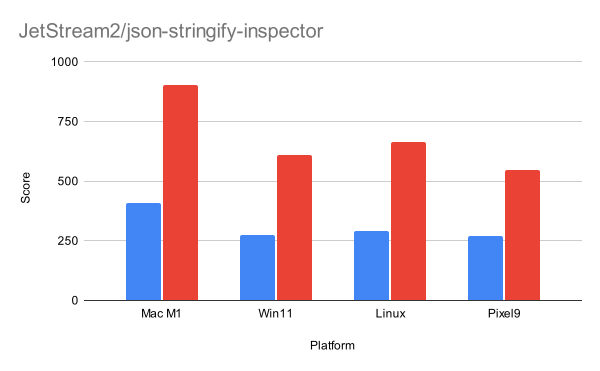
With the new architecture in place, the team ran extensive benchmarks. The results showed a 2x speedup (or more) for typical data serialization tasks. The iterative traversal also lifted the practical nesting limit from around 10,000 to well over 100,000 levels. Memory profiling confirmed that the templatized string handling reduced per-call overhead. The optimization shipped in Chrome 114+ and Node.js 20+, offering an immediate benefit to millions of applications without any code changes.
Tips and Conclusion
- Keep your objects plain: The fast path works best with objects that have no custom
toJSON(), no getters, and no proxies. If you can avoid these, you get free performance. - Be aware of string types: If your JSON contains many non-ASCII characters, the two-byte path still handles them efficiently, but try to stay ASCII-heavy when possible.
- Understand the trade-offs: The templatization increases binary size, but for most apps the extra kilobytes are negligible.
- Test deep nesting: If you serialize deeply nested objects (e.g., configuration trees), the new limit gives you more headroom.
- Check compatibility: Ensure your runtime (browser or Node.js) has the optimization – it’s available from Chrome 114 and Node 20.
The V8 team’s work shows that even a mature, highly optimized function like JSON.stringify can be substantially improved by rethinking core assumptions. By eliminating side-effect checks, adopting an iterative approach, and specializing string handling, they delivered a faster JSON for everyone. Now you know exactly how – and where to look for similar wins in your own projects.