V8's JSON.stringify Optimization: A Q&A on Doubling Performance
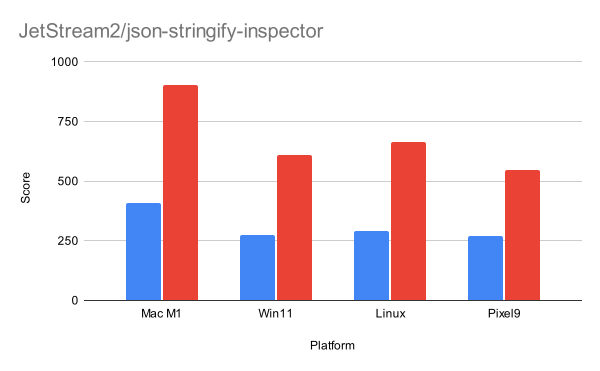
JSON.stringify is a cornerstone of JavaScript, used everywhere from API calls to data storage. Recently, the V8 team achieved a remarkable feat: they made it more than twice as fast. This Q&A breaks down the technical wizardry behind this performance boost, exploring the new fast path, string handling, and real-world impact.
Why is JSON.stringify performance critical for web applications?
JSON.stringify is a fundamental operation in modern JavaScript. Whenever you send data to a server, save preferences to localStorage, or even clone an object, you're likely relying on it. The speed of this function directly affects page load times, responsiveness, and user experience. A faster JSON.stringify means quicker serialization of network payloads, less jank during data persistence, and more fluid interactions. In real-world scenarios, even small improvements in this core operation can reduce overall latency—especially in data-heavy apps like dashboards, real-time tools, or web workers that process large objects. This is why V8's effort to double its speed is such a big deal for developers and users alike.
What is the side-effect-free fast path and how does it boost performance?
The centerpiece of the optimization is a new fast path that V8 takes when it can guarantee serialization will have no side effects. Side effects include anything that breaks the straightforward traversal—like executing user-defined code (toJSON methods) or triggering garbage collection during string flattening. By identifying objects that are plain data (no custom logic), V8 sidesteps dozens of conditional checks and defensive measures built into the general serializer. This streamlined version runs much faster, especially for common patterns like JSON-like objects or arrays. It also uses an iterative, not recursive, approach. That eliminates stack overflow checks and allows nesting depths that previously would have failed. The result: a direct speedup of over 2x for the most typical use cases.
Why is an iterative serializer better than a recursive one?
The old general-purpose JSON.stringify used recursion, which has inherent overhead: each function call requires stack management, overflow detection, and state preservation. The new fast path is iterative, meaning it processes objects using loops and a manual stack. This eliminates the need for stack limit checks—freeing up CPU cycles—and avoids the risk of stack overflow with deeply nested objects. It also makes it easier to resume encoding after changes or to pause, because the state is stored explicitly rather than in call frames. For example, developers can now serialize deeply nested graphs (like complex tree structures) that previously would have thrown a “maximum call stack size exceeded” error. The iterative approach is more efficient and more robust for real-world data.
How does V8 handle different string representations in the new serializer?
Strings in V8 come in two internal flavors: one-byte (for ASCII-only) and two-byte (for any Unicode). The old serializer had to check each string's encoding at runtime, leading to constant branching. The new code is templatized: V8 compiles two separate versions of the serializer—one optimized for one-byte strings, the other for two-byte strings. This eliminates encoding checks inside the hot loop, improving cache locality and instruction pipelining. The performance gain is especially noticeable when serializing large strings or many small strings. When a string uses mixed representations (like a ConsString that could trigger GC), the fast path inspects the instance type and falls back to the slow path if needed. This hybrid approach keeps the fast path lean while gracefully handling edge cases.
What are the limitations or fallback scenarios of the fast path?
The fast path only activates when serialization is guaranteed side-effect-free. That means objects with custom toJSON methods, or those containing functions, Symbols, or other non-serializable values, force V8 to use the slower general-purpose path. Similarly, if a string is a ConsString that requires flattening (which could trigger GC), the serializer falls back to the safe route. The fast path also cannot handle circular references on its own—that check remains in the slow path. In practice, most plain data objects (like API responses, configuration objects, or simple arrays) hit the fast path. But developers should be aware that adding toJSON to an object will opt it out of the optimization. Despite these constraints, the fast path covers the vast majority of real-world usage, making the overall performance improvement dramatic.
How does this optimization translate to real-world application performance?
Doubling the speed of JSON.stringify has direct, measurable benefits. For an e-commerce site sending product data to a client, serialization time is cut in half—meaning faster initial page loads and smoother search results. For a data analytics dashboard that refreshes every few seconds, less time spent on serialization frees up the main thread for rendering and user input. Mobile users especially benefit because slower devices are more sensitive to micro-optimizations. The improvement also reduces battery drain by completing work faster. While the exact gain depends on the object size and complexity, benchmarks show consistent 2x speedups for typical JSON payloads. This optimization is already shipping in the latest V8 versions, so developers can expect faster apps without changing a single line of code.