Boosting JSON.stringify Performance: How V8 Achieved a 2x Speedup
The Quest for Faster Serialization
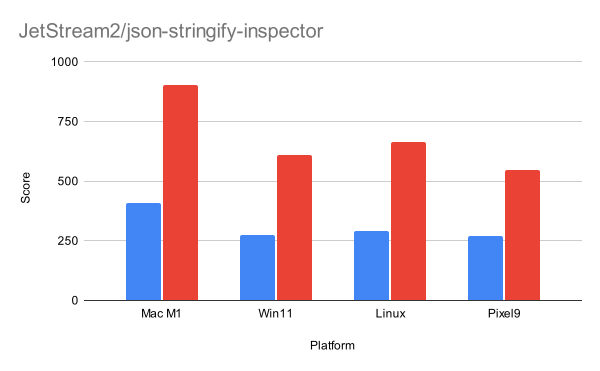
JSON.stringify is a cornerstone of JavaScript development, quietly powering countless operations that developers take for granted. Whether it's preparing data for a network request, saving state to localStorage, or creating deep copies of objects, the speed of this built-in function directly impacts user experience. A laggy serialization can lead to sluggish page interactions and delayed responses, especially in data-heavy applications. That's why the recent performance improvement in V8's implementation of JSON.stringify is such a milestone: it's now more than twice as fast as before. In this article, we dive into the engineering decisions that made this leap possible.
The Problem: Side Effects and Slow Paths
For years, JSON.stringify had to be a defensive generalist. The core challenge was that serializing an object could trigger unexpected behaviors — known as side effects — that broke the straightforward traversal of the object graph. Side effects include not only obvious cases like executing user-defined toJSON methods or custom replacer functions, but also subtle internal actions such as triggering garbage collection cycles when flattening certain string types. To safely handle every scenario, the old serializer included numerous runtime checks and fallback logic, which slowed down even the simplest serialization tasks.
Why the General-Purpose Approach Was Slow
A recursive algorithm formed the backbone of the general-purpose serializer. Each recursive call required stack overflow checks, state management for nested objects, and constant branching to determine the type of the current value. This overhead was acceptable for rare, complex objects, but it penalized the most common use cases: serializing plain JavaScript objects made of simple strings, numbers, and arrays. The need for a more efficient path became clear.
A Breakthrough: The Side-Effect-Free Fast Path
The key innovation is a new fast path that V8 can take when it can guarantee that serialization will not produce any side effects. If the object graph consists entirely of primitive values and plain objects without custom serialization hooks, V8 switches to a highly optimized, specialized implementation. This fast path bypasses the expensive checks and defensive logic of the general-purpose serializer, resulting in a dramatic speedup for the most common data structures.
Avoiding Side Effects: The Core Guarantee
To stay on the fast path, V8 must verify that none of the following side effect triggers are present:
- Custom
toJSONmethods on objects - Replacer functions or arrays that could modify the serialization
- String types like
ConsStringthat might require flattening (and thus trigger GC) - Proxy objects that may intercept property access
When any of these are detected, V8 falls back to the general-purpose slow path. For more details on what constitutes a side effect and how to avoid them, see Practical Implications and Limitations.
Iterative Architecture: Smarter and Deeper
Unlike the old recursive approach, the new fast path is iterative. This architectural change eliminates the need for stack overflow checks and allows V8 to quickly resume after encoding changes (e.g., switching character encodings). Moreover, it enables developers to serialize significantly deeper object graphs than before, because the iterative approach does not rely on a fixed call stack. The result is not only faster, but also more robust for complex nested data.
String Handling: One-Size Does Not Fit All
Strings in V8 are represented in two formats: one-byte for strings containing only ASCII characters, and two-byte for those with any non-ASCII characters. The two-byte representation doubles memory usage per character, which also impacts serialization performance. The old serializer had to constantly branch and check the character type, adding overhead.
Templatized Stringifier for Maximum Speed
To eliminate these runtime checks, V8 engineers templatized the entire stringification logic on the character type. The result is two distinct, compiled versions of the serializer: one fully optimized for one-byte strings and another for two-byte strings. This increases binary size, but the performance gains are well worth it. During serialization, V8 inspects each string's instance type to decide which path to use. If a string type that cannot be handled on the fast path is detected (like a ConsString that might trigger GC during flattening), V8 seamlessly falls back to the slow path.
Practical Implications and Limitations
While the 2x speedup is impressive, it's important to understand when the fast path applies. Objects that use toJSON, custom replacers, or rely on proxies will not benefit directly — they will still use the general-purpose serializer. However, in modern web development, the majority of serialization tasks involve simple, plain data objects (e.g., API responses, configuration objects). For these, the improvement is significant. Developers who want to maximize performance should ensure their objects avoid triggering side effects wherever possible.
Mixed Encodings and Edge Cases
The implementation handles mixed encodings efficiently. When a string contains both ASCII and non-ASCII characters, V8 must fall back to the slower path because the two-byte variant cannot handle one-byte substrings. This is a necessary trade-off to maintain correctness. For typical JSON payloads (which are often ASCII), this scenario is rare.
Conclusion: A Major Leap Forward
The optimizations described here — a side-effect-free fast path combined with an iterative architecture and templatized string handling — have made JSON.stringify in V8 more than twice as fast. This translates to tangible improvements for every web application that relies on serialization, from faster initial page loads to smoother data interactions. As JavaScript continues to power increasingly complex applications, such foundational performance gains help keep the web responsive and efficient.
For developers, the key takeaway is to keep your serialized data as plain as possible to take full advantage of the fast path. The future may bring even more optimizations, but for now, JSON.stringify has taken a big step forward.